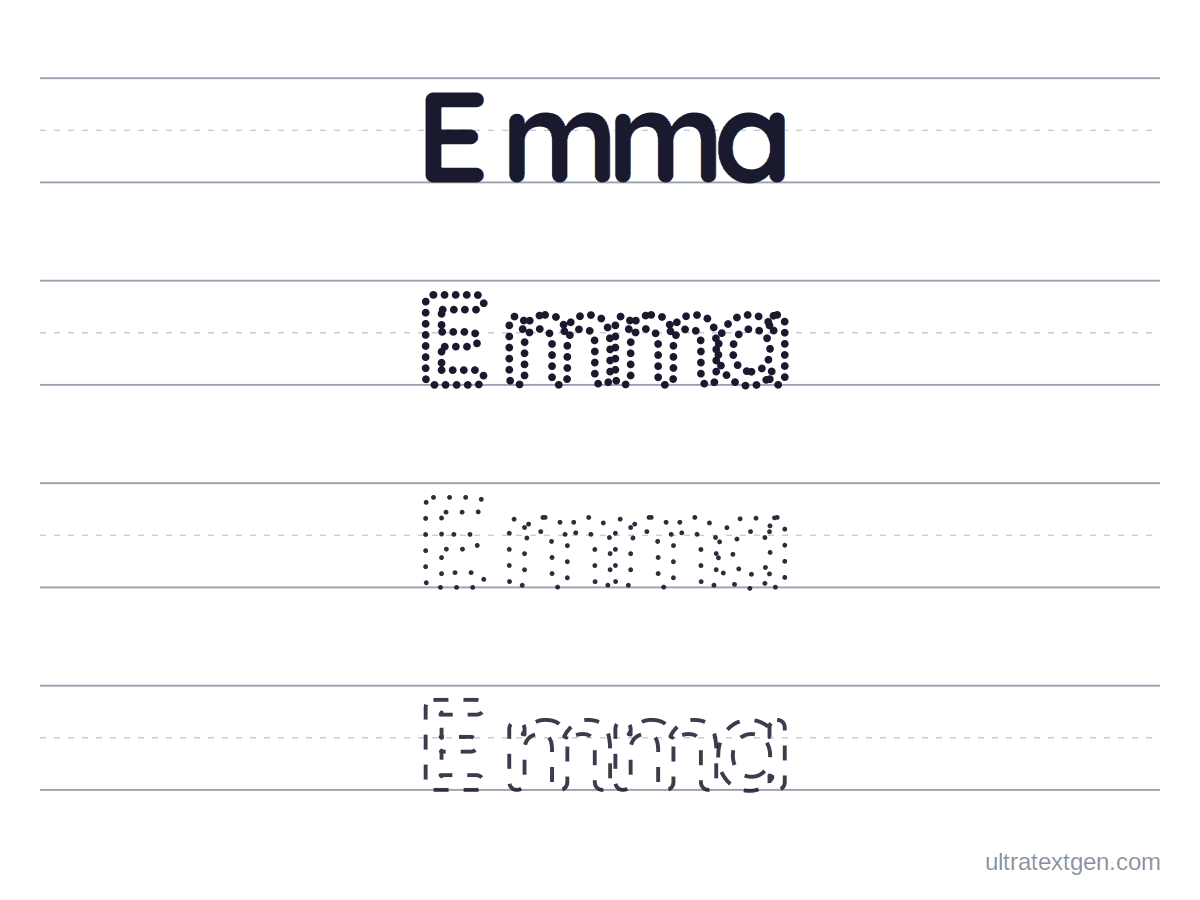
Make your own handwriting worksheet in seconds. Type any name or words, tap a
difficulty level from bold dotted letters to a blank line, and watch the sheet
build live. Great for Pre-K to Grade 2, and adult handwriting practice.
Free, no sign-up, print or save a PDF/PNG.
Build your worksheet
Type a name or words, tap a difficulty level, and the sheet builds live on the right. Print it, save a PDF, or download a PNG. Free, no sign-up.
Start by age (optional shortcut)
Difficulty level (tap one, nudge up as they improve)
Building at Level 2 · Bold dotted: thick, closely-spaced dots to join.
Stroke direction adds a numbered start dot and arrows to each letter, showing which way to draw it.
Class set: one sheet per name
Paste your class list (up to 60 names) and Download PDF builds one worksheet per name at the difficulty picked above. Download PDF saves the whole set as one PDF. Download PNG saves the single name typed above.
Live preview
Runs entirely in your browser. Nothing is uploaded. Download PDF keeps a copy you can print any time.
How the difficulty works
Every difficulty level combines three things a teacher thinks about: how thick
the guide is, how close the dots sit, and how dark the letters
are, so one tap cleanly raises or lowers the challenge. The seven levels run from a
solid model to trace on top, through bold dotted,
fine dotted, dashed, faded ghost and
faint guide, all the way to a blank ruled line for writing from
memory. Start easy and move up a single notch as a child’s control improves.
Not sure where to start? As a rule of thumb, Pre-K does well with bold dotted,
Kindergarten with fine dotted, Grade 1 with dashed, and
Grade 2 and up with a faint guide before writing solo. Adults relearning
penmanship often start at faded ghost and drop to a blank line. The age buttons jump to a
sensible level, then fine-tune with the ladder.
Type a name or a few words, tap an age preset or a difficulty level, then click
Download PDF. The sheet includes a solid model row, several rows at your
chosen difficulty to trace, and blank ruled lines for free practice. You can also download it as a PNG.
The seven levels get gradually harder: solid model, bold dotted, fine dotted,
dashed, faded ghost, faint guide, and blank line. Each level combines three things a teacher thinks about:
stroke thickness, how close the dots sit, and how dark the letters are, so one control cleanly raises or
lowers the challenge.
As a starting point: Pre-K works well with bold dotted letters, Kindergarten with fine dotted, Grade 1 with
dashed, and Grade 2 and up with a faint guide before writing solo. Use the age presets to jump to a sensible
level, then nudge up a notch as the child gets more confident.
Yes, completely free, with no sign-up, watermark, or limit. Everything is generated in your browser, so you
can make as many worksheets as you like for any name, word, or difficulty.
Yes. Open Class set: one sheet per name, paste your class list with one name per line (up to 60 names), and Download PDF builds one personalized worksheet per student at the difficulty you picked. Download PDF saves it “Save as PDF” to keep the whole set as a single PDF file.